Reading Borges part 1: No one actually wants a forest

Most training plans assume that tomorrow will function more or less like today. The same athlete with the same capacities. Just add a little more load, or do a little more of the same, and the response will be progress.
But anyone who has coached for more than a season knows how fragile that assumption is. A bad night of sleep, a small ache, a missed lift, a lost game, a loss of confidence and suddenly the plan that worked so well no longer fits the person standing in front of you.
At that moment, the problem isn’t effort or discipline. It’s that the map you were following no longer matches the terrain. I didn’t find a language for that moment in training textbooks. I found it in the short fiction of Jorge Luis Borges.
Borges writes about uncertainty, infinity, chance and time, all systems that can’t be fully mapped. This is a useful counterweight to the linear habits coaching often falls back on. His work refuses neat explanations, and that refusal can shake loose old ways of thinking or, just as usefully, strengthen them if they still hold.
While Borges is not a theorist of learning, he may be the best writer we have on what it feels like to push a system beyond its current limits, to look ahead without knowing how things will work out, and isn’t that what it feels like to learn?
Historically, both coaching practice and cognitive science have leaned toward control narratives. If you can break a skill into parts, sequence them correctly, and repeat them enough times, improvement should follow. That logic is tidy, attractive, and reassuring, especially in environments that crave measurable outcomes.
If you listen to how people talk about learning, you’ll notice a strange pattern: progress is often imagined like a graph in a powerpoint diagram: a line moving steadily upward, with a dip here and there for tasteful realism. Put in good work, repeat the correct pattern, follow the program, and the skill will “stick”.
Pedagogy absorbed the assumptions of industrial thinking: standardize the input, get standardized outputs. Psychology focused on error reduction: eliminate variability, reinforce the desired behavior. Sports coaching embraced the notion of an “ideal technique” and set out to sculpt athletes into approximations of biomechanical models.
It comes as no surprise, then, that exercise science absorbed these assumptions as well. Most planning of training assumed a top-down approach where adaptation could be predicted so reliably that you could plan backwards from a desired future capacity. Clear phases, defined objectives, load progressions that marched forward with the confidence of a train timetable.
The application of such models is highly structured and provides clear definitions at each stage. The idea is that peak performance arrives in a controlled way as the phases are neatly stacked on top of each other, maximizing the chance of hitting performance goals while minimizing the risk of overtraining.
But this requires a strict commitment to finishing each phase before starting the next, which introduces obvious problems. What happens if the athlete doesn’t respond to training the way we thought? What happens with injuries or illness? Do we keep building? Do we go back? And if we go back, where to? To the point where we got held up? Or do we account for the capacity we may have lost during sick leave?
A runner struggling after an illness isn’t just “behind schedule”, their whole rhythm of training shifts, and the neat phases we planned suddenly feel like papers caught by the wind.
But these are disturbing questions, that simply did not fit the dominant metaphors of the time: machines, programs, spreadsheets, blueprints. Machinery doesn’t like wobble. Athletes however, they wobble. All the time.
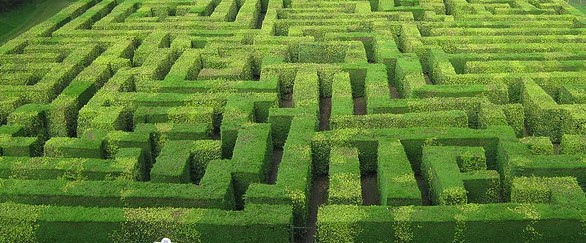
In 1941 Borges published his short story The Garden of Forking Paths. In it he drops you in the middle of things. The first two pages are missing. Already, you’re off-balance. On the surface it looks like a spy story at the end of the first world war. A man on the run, pressed for time, trying to send a message to his German allies before being captured.
The narrator, Yu Tsun, tells us what happened after his cover was blown and he had only hours to act. Halfway through, the story changes tempo completely. The urgency dissolves, and instead of action, we are led into a quiet conversation about theories of time, labyrinths, and a strange book written by Yu Tsun’s ancestor, a book that was never meant to make sense in a linear way.
When the story returns to action, it does so abruptly. A murder takes place. The message is delivered, and the mission succeeds. And yet, it doesn’t feel right. The story leaves you with the sense that you’ve missed something.
At this point the reader has a choice: shrug and move on, or go back and read again. Those who do read again, with appropriated knowledge from the first pass, suddenly see how lines in the story that at the first reading appeared to be gibberish now makes sense. The story you thought was a spy plot is now something else entirely: a story about choices, consequences, and possibilities and that all possible futures exist, at the same time.
And read it again, with the knowledge about that, and yet another thread emerges, one that suggests the opposite of multiple possibilities, that whatever actions characters would have taken the outcome may have been fixed all along. There is a sudden insight, one that could not be made during the first few readings of the story, that the idea that all possible futures are realized at once is grand, but it doesn’t change much for us. Even if it was so, we never see those other worlds, and the only reality we can know is the one we live.
Borges leaves you without a map, and without the possibility of one. The only thing you are allowed to experience is the path you are on, now.
Isn’t this what practice feels like from the inside? Not a line in a power point, but branching paths. Each repetition changes what future repetitions are possible, and closes others. No privileged route, no secret shortcut, only the ongoing process of constantly selecting, adjusting, and navigating.
Notice. Choose. Move forward.
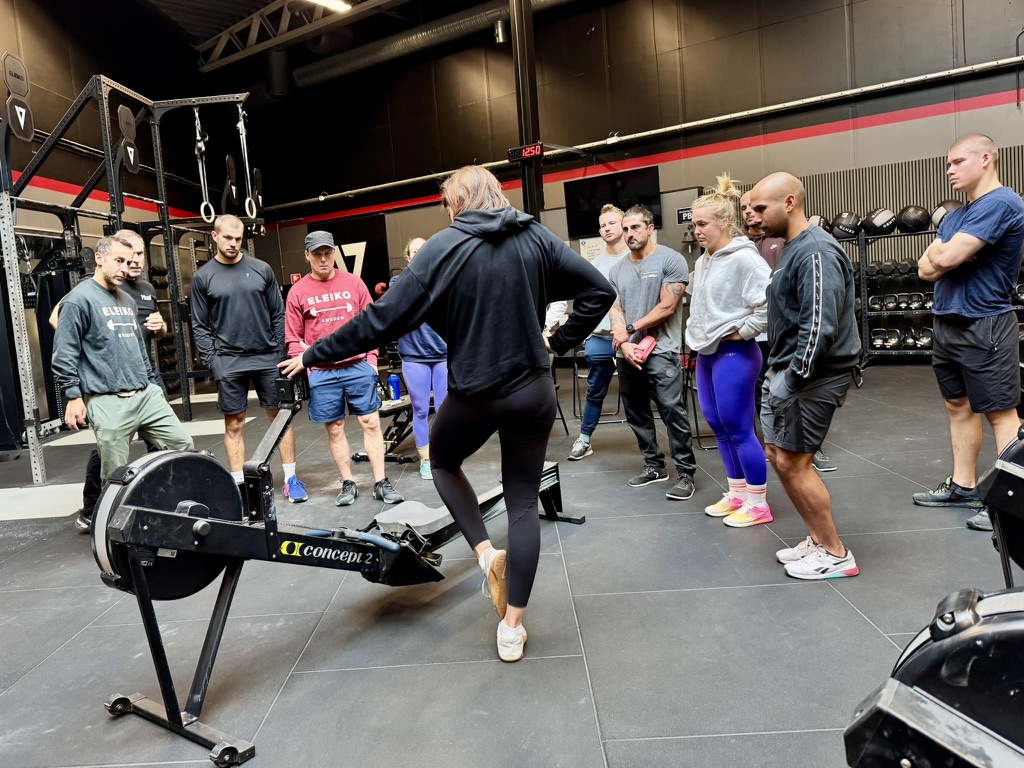
Even though the field of physiology already in the 1960s and 1970s moved on to more complex explanatory models for adaptation, shifting from homeostasis (“maintain a fixed baseline”) to allostasis (“constantly reorganize to meet changing demands”), training planning stayed rigid.
Pedagogy moved from linear, information-processing models toward ecological, relational, and systems-based explanations. Exercise science, even today, still leans heavily on Hans Selye’s theories of stress from the 1930s.
Coaching practice however had noticed the shift, and today there are considerable gaps between science and best practice, how training principles and training methods actually are applied. Today the term “ecological” gets thrown around also in our field.
But our tools remain built for sets, reps, percentages. You can’t put something vague into a spreadsheet. The times had no wiggle-room, so the planning stayed linear even after the understanding shifted.
“Ecology” sounds appealing enough, but no one actually wants a forest. They want a map, clear lines, predictable outcomes.

The real challenge isn’t being convinced, in theory, that the world isn’t linear. The challenge is acting non-linear. Partly because linear thinking is what most courses and training literature teach us, but also because the language of clear, predictable consequences is baked into the world, not just in training, but everywhere we look.
Can we use Borges here, not as a criticism, but as a kind of metaphor for how one can think in a different way, or at least approach such thinking?
To borrow Borges’s imagery: when we coach, it’s less about trying to guide people along the “correct” path through their labyrinth, because such a path might not exists, and even if it did, we wouldn’t be able to see it.
Our job as coaches isn’t to simplify complexity but to help the athlete stay with it without becoming overwhelmed, and then, when the moment is right, raise the demands. Regression isn’t failure, but reorganization (that may or may not be favorable in the long term). Standstill, on broader scale, is a neccesary prelude to the branching of possible next steps, and as such nothing to fear but to live with.
In a forest, progress isn’t something you march towards. It’s something that grows around you.

Still, all too often, when coaches, or any other theoretician shines the light on “what others do” or “what this theory says”, they stop after pointing at what might be a problem with that practice or theory. The internet is full of commentary and remarkably short on usable advice. To turn theory into practice, we need to go all the way: the real process, real situations. What would I actually do here? Get some real skin in the game, not just watch from the sidelines.
Contrary to the common saying: it doesn’t matter how big a toolbox you have, how many cues, drills, or clever progressions you’ve collected, if you haven’t also trained your coaches eye to see how situations differ. Case examples force you to look, to compare, to discriminate, to ask “why this here?” They keep you from assuming sameness where there is variation.
https://www.youtube.com/watch?v=1Lv1IyigIUY
The snatch is used in sports because it develops superior, full-body athleticism by building explosive power, speed, strength, coordination, and mobility, crucial for activities like sprinting, jumping, throwing, and hitting, while also enhancing core stability and injury prevention through its complex, high-velocity, full-body movement pattern.
It is both one of the simplest movements and one of the most complex. On paper, it’s just one instruction: lift a barbell from the ground with straight arms and catch it overhead, also with straight arms. But the moment you try it, you discover it’s also a very long, continuous sequence, moving the bar the greatest distance it can possibly travel, from the floor to full overhead lockout, while you drop under it, and then stand it up.
Each position in the snatch has to allow you to put force into the bar in a useful direction. If you add speed in the wrong direction, your strength becomes a problem rather than helpful. The faster the bar is moving off-line the harder it becomes to bring it back and save the lift.
Each position, then, is a kind of branching point. Your ability to find that position and control it shapes what paths remain available to you next. A sound position opens up possibilities, a poor one collapses them. Those possibilities aren’t knowable in advance, you discover them by getting there.
We need to plan and prescribe training, to give it direction and fit it into our lives. We usually do this by stipulating sets and reps and the weight to be lifted. That works, up to a point. But it says very little about how the weight is moved. To address that, we need more than volume and load. We need a language, a framework, that lets us prioritize and strengthen positions within the lift.
That’s why we, when we coach this lift, should look for the first position that breaks down, rather than trying to fix whatever goes wrong later in the lift. Those later errors are usually just the visible consequences of an earlier misalignment. Until the root position is addressed, the downstream problems aren’t really “fixable”. They’re symptoms of a branching that already happened.
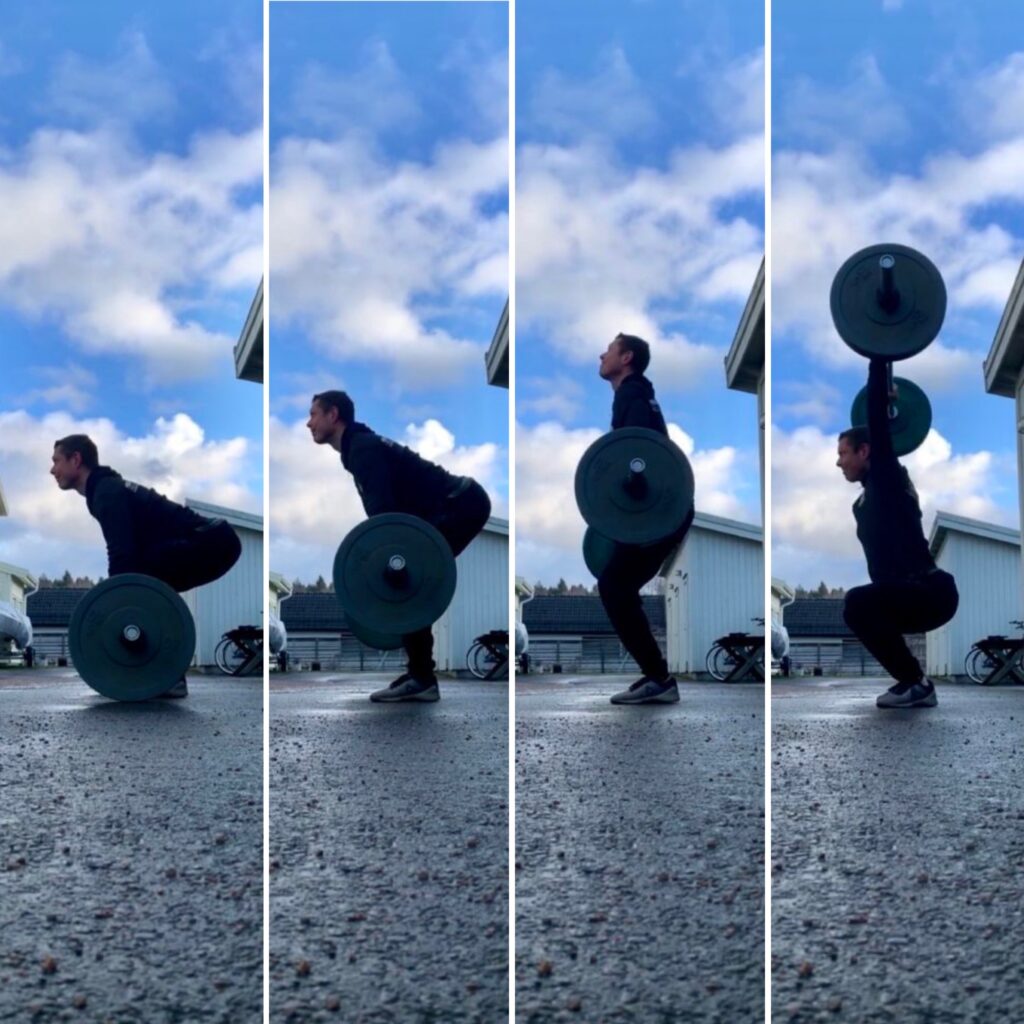
Branching positions of the snatch. From left to right: starting position, bar at knee, power position, catch position
Having identified at what branching point in the snatch begins to break down, the position where our ability to organize internal and external force forces us out of position, we design drills toward strengthening the transition from the last position the athlete can still control to the first one they cannot. That is this athlete’s true edge of skill.
External demands (heavier load, faster bar speed), internal limits (strength, mobility, coordination), and the athlete’s psychological state (confidence, hesitation, fear of missing, arousal level) all shift where that edge shows up.
What this process gives us is not a way to perfect technique, but a way to locate where technique is currently possible. Progress, then, is less about chasing an ideal version of the snatch and more about widening the corridor of stable options the athlete can navigate. Coaching becomes the work of helping the athlete explore more of it without being overwhelmed.
My process is then:
1. Identify the first branching point where the athlete loses control of the bar’s direction. Look for loss of balance, posture, or force orientation.
2. Design practice that strengthens that specific position. This is often made unnecessarily complicated. You rarely need exotic drills or movements unrelated to the task. My approach is almost always some variation of:
- Finding and holding the position - lowering into it deliberately and stabilizing it.
- Starting the lift from that position - reducing everything except the transition we care about.
- Starting from the preceding position - adding just enough context to challenge the transition.
- Performing fuller versions of the lift - but limiting complexity by slowing the approach into the compromised position, adding pauses, or otherwise damping the speed of error.
3. Evaluate progress continually, remembering that stability at one load (or, remembering the influence from the psychological state of the athlete, even a specific day!) doesn’t guarantee stability at the next. As soon as external demands change, the capacity to control key positions of the lift may again be insufficient, and the work of strengthen that ability begins again.
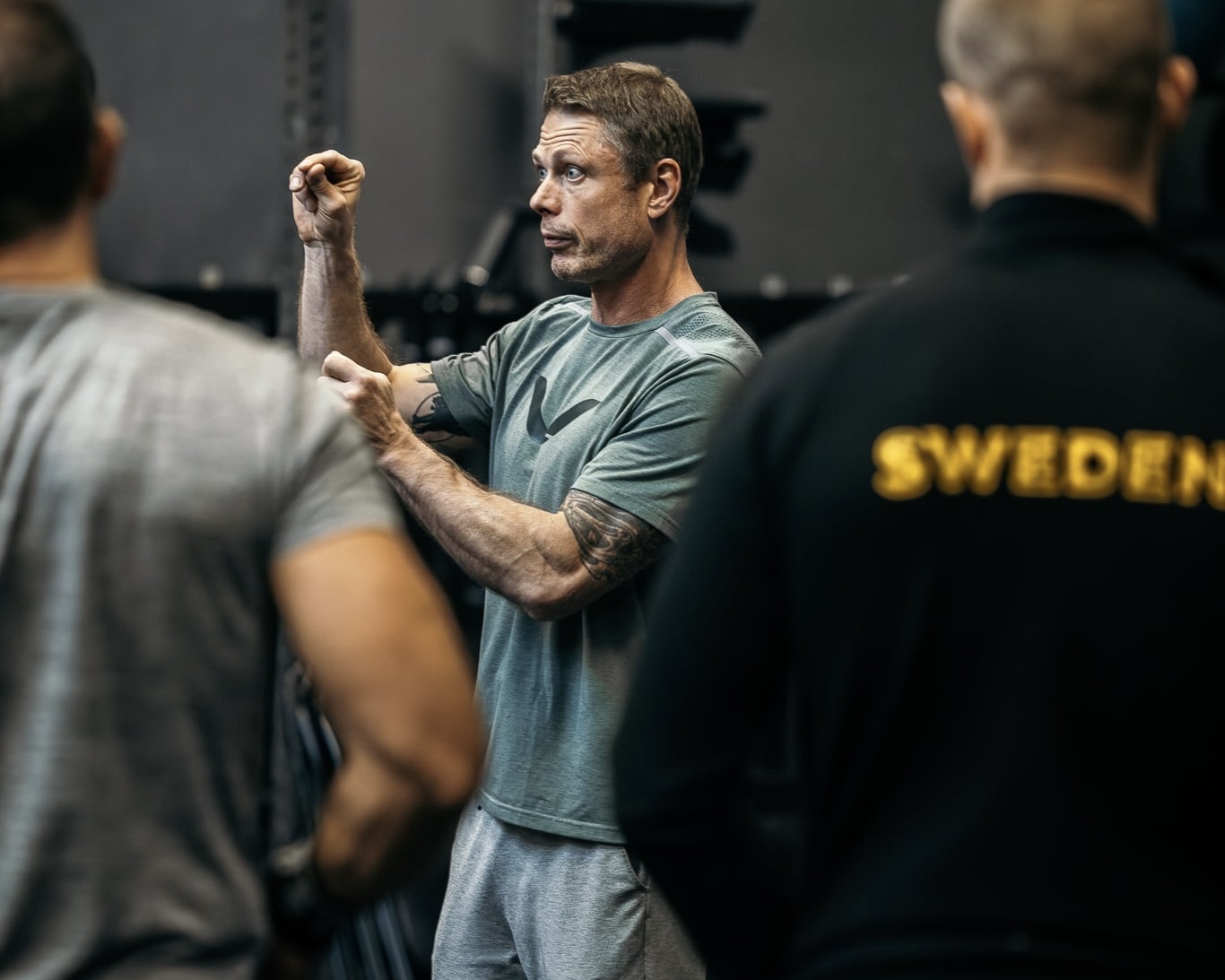
Could the same argument be made without involving Borges at all? Probably. But engaging with stories like this trains us to notice the moment where systematic explanation runs out and living systems begin. Exercise science alone, for all its contributions, still struggles to describe that territory.
Research and studies is very important, of course, but also fiction, biographies, essays. Not because they explain reality better, but because they resist simplifying it. They train you to notice context, to hold more than one perspective at once, and to see differences where you might otherwise assume sameness.
What this awareness allows is something practical. The branching positions of the snatch are not metaphors, but places in the movement where futures actually diverge. Designing practice around them is a way of working with the system as it is, not as the spreadsheet wishes it to be.
Still, it would be a mistake to read this as an argument against variation or full-movement practice. Slowing the lift down, isolating transitions, or emphasizing specific positions can reduce complexity enough for the athlete to regain control where it was lost. But reducing a movement also reduces its errors. Error, as long as it isn’t catastrophic, is simply variation.
Variation is protective. There isn’t much learning in a “perfect” lift. So the goal is to reduce complexity only to the point where learning becomes possible again, but not so far that learning disappears with it.
- “The garden of forking paths”, Jose Louis Borges, https://www.basearts.com/artquest/handouts/NEWMEDIA/The%20Garden%20of%20Forking%20Paths.pdf
- “A labyrinth of symbols - exploring “The garden of the forking paths”, Ethan Weed, https://www.borges.pitt.edu/sites/default/files/1808.pdf
- ”The Training and Development of Elite Sprint Performance: an Integration of Scientific and Best Practice Literature”, https://www.ncbi.nlm.nih.gov/pmc/articles/PMC4975196/
- “Bernstein’s construction of movement model and contemporary motor control and motor learning theories”, Waclaw Petrynski, https://www.researchgate.net/publication/286581128_Bernstein's_construction_of_movement_model_and_contemporary_motor_control_and_motor_learning_theories
- “The end is just the beginning”, Martin Altemark, https://martinaltemark.fortime.se/2020/04/03/the-end-is-just-the-beginning/
- “Seeing Like a State”, James C. Scott, https://yalebooks.yale.edu/book/9780300078152/seeing-like-a-state/