How far can we take this, pt 2

In the first part of this series, we went through the research in the area of sprint cycling, and learned the physiological reality of sprint cycling: the decisive role of muscle volume, the mechanics of the force–cadence relationship, and how the demands shift between different events.
But… if you are reading this blog, you already know that cyclists need to lift weights. You are already familiar with the basic prescription of going heavy for squats and deadlifts. Yet, if we look at any training group, we see a massive variation in how that strength translates to performance.
The philosopher Ludwig Wittgenstein once said, when speaking of Hegel, the father of dialectics, that Hegel always seems to say that things that look different are in reality the same, whereas his own interest was to show that things that look the same in reality are always also different. Coaching lives precisely in this tension.
Every rider has different genetics, different equipment, different levels of stress, and different lives outside of training. One solution would be to write a completely individual program for every athlete. In theory, that sounds ideal. In practice, I think it would be a mistake.
A training group is not simply several riders occupying the same gym or track. It is a social and psychological system whose value is greater than the sum of its parts.
When everyone faces the same session, the struggle becomes shared rather than private, and everyone is carrying part of the burden. Younger, faster riders pull the masters athletes into speeds they might never choose on their own, while the experienced riders help with pacing, positioning, discipline, and habits that cannot easily be written into a program.
The program that follows is therefore intentionally shared, while the principles of implementation that must follow with that are intentionally individual. The challenge is not to replace universal principles with endless personalization, but to use those universal principles intelligently enough that every rider can become as fast as their own capacity allows.
We know that sprint cycling is fundamentally about being able to produce maximal force quickly, transfer it efficiently to the pedal, and hold it together long enough to win the race. In practice, this means that we first build the engine and then express it on the bike under the coordination and fatigue demands found in the flying 200 m, 500 m, and 1000 m.
First and most important are muscle mass and muscle architecture. In elite cohorts of sprint cyclists, quadriceps volume alone accounted for 76 percent of the variance in peak power, and when hamstring volume plus the pennation angle of the vastus lateralis are added, almost all the remaining variance is explained. That is why we treat the gym as a foundation, not as a supplement: more relevant muscle mass and better architecture make the rest of the training more worthwhile.
Next comes how quickly force can be delivered. Pedal strokes happen fast, so we need to stimulate the nervous system and the force–cadence side with explosive lifts, isometric exercises performed with maximal intent, and short, hard bike sprints that reach the intensity required to move your “coordination ceiling.”
Then comes tendon stiffness. A stiffer tendon helps transfer force faster and is associated with the sprint profile: sprint cyclists show greater thickness and stiffness in the quadriceps and patellar tendons than endurance cyclists. This quality is best trained with long-duration isometric holds at long muscle length, typically 20–30 seconds at about 70–75% of maximal voluntary force. In studies, this has clearly increased tendon stiffness while also reducing EMD. It takes months to build and disappears faster than muscle during time off, which is one reason why we do not “fast-track” this component but place it regularly throughout the week.
Finally come cadence specificity and pacing. The flying 200 m, about 10–12 seconds, is almost entirely neuromuscular and alactic, and is largely about force–cadence and the nervous system. The 500 m, about 35–45 seconds, is almost entirely glycolytic anaerobic, where your glycolytic capacity and your ability to keep producing high power as fatigue degrades quality become decisive. The 1000 m, about 60–75 seconds, also has a significant aerobic contribution, estimated at 30–40%, which makes pacing and the ability to keep mechanics together under high-acidosis conditions especially important.
The hierarchy is therefore: muscle mass and architecture, tendon stiffness, force–velocity optimization, and technical specificity on the bike. Everything is connected, but if something must be prioritized, that is the order.
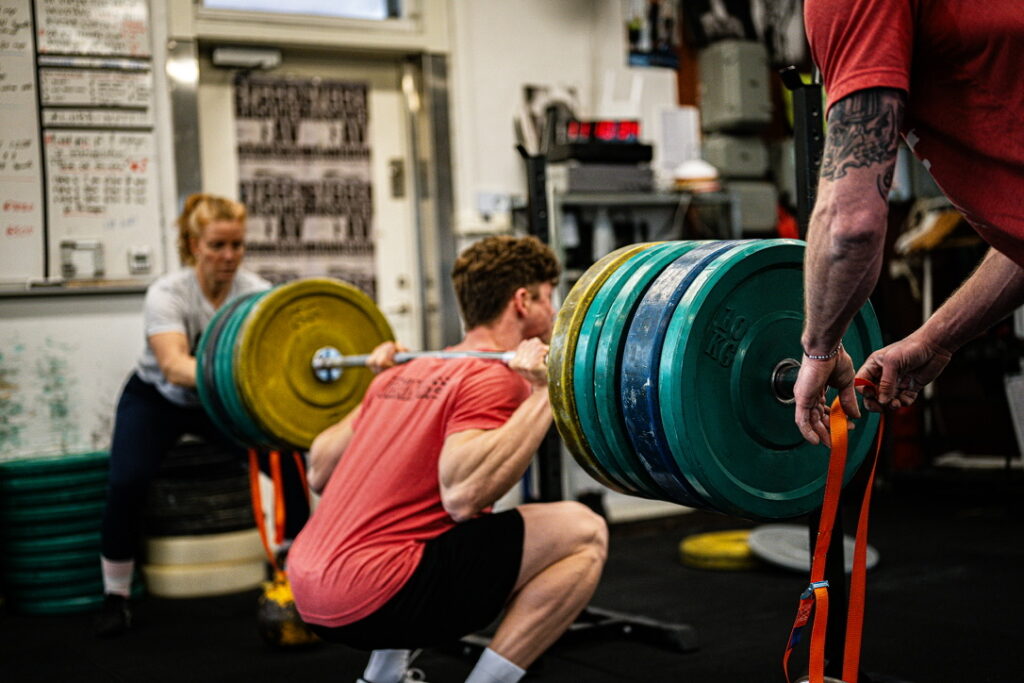
The setup is a three-week loop with four sessions per week: two gym sessions and two bike sessions. Over three weeks, we rotate six distinct bike sessions, two per week, so that you get regular contact with starts, top speed, the 500 m feel, and 1000 m rhythm without getting stuck with the same stimulus week after week.
The point is that we never want to completely drop any part that is important for performance. If you only train what you are already good at, you often become even more specialized in exactly that, but you do not necessarily become faster on the track, where the whole system (engine, transfer, and coordination under fatigue) decides the outcome. We therefore vary the focus between weeks and loops, not only because it is more enjoyable, but because the same stimuli week after week tend to produce diminishing returns and make it harder to maintain high quality in the hardest components.
Another point is that we rarely know exactly what will make you faster right now. That is a good argument for doing a little bit of everything all the time, rather than clearing out everything except one thing and hoping it hits the target.
The three-week loop is also easy to “reset.” If a week goes sideways because of work, illness, or life in general, you start again from week one in the next loop, and because week one contains more of the most important things to maintain often, it rarely becomes a practical step backward.
The session order is flexible with one exception: keep at least 48–72 hours between the heavy gym session, focused on morphology and force capacity, and the next high-quality bike session so that the bike work feels “crisp” rather than survival-based.
As aerobic filler, you can add an easy 30–45 minute spin on a rest day but treat it as optional and low-cost. Data from world-class sprint cyclists show that they place about 15–16% of their total load in zone 1, but this should be removed if it creates fatigue that affects the quality sessions.
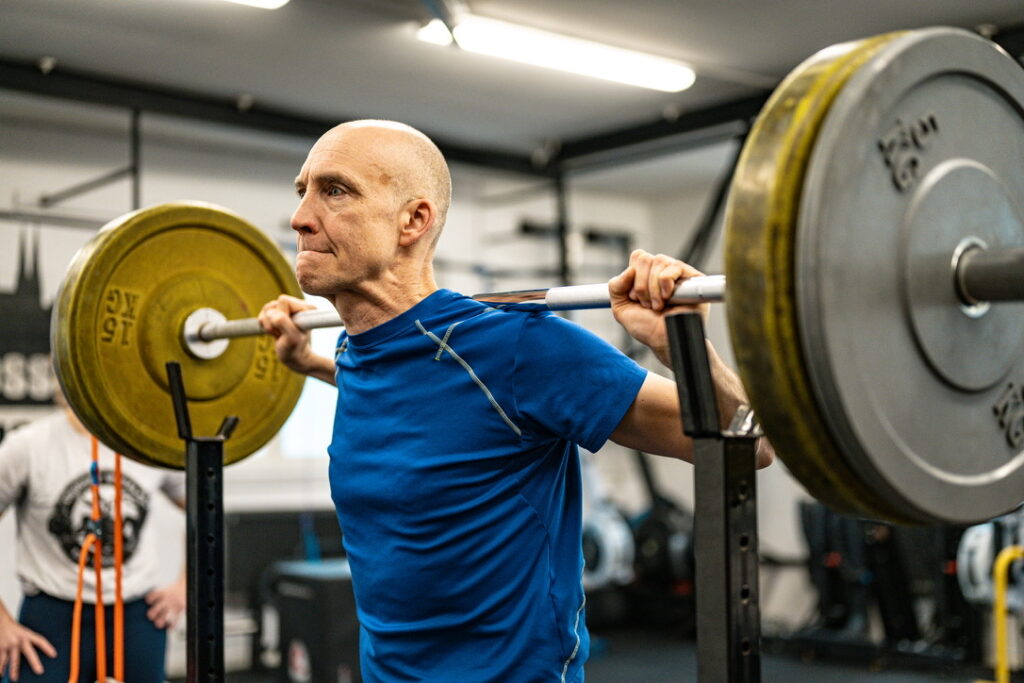
Gym Sessions
Gym Session 1 — Volume and Force Capacity
This session handles the foundation: muscle mass, pennation angle, and maximal force (in other words, the “engine” of sprint performance). It is the heaviest session of the week, and you should schedule it so that you have at least 48–72 hours before the next high-quality cycling session. Expect about 60–75 minutes and keep the focus on quality rather than chasing more total volume once technique starts to break down.
Warm up with 5 minutes of easy cycling or rowing, then do a couple of moderately heavy goblet squat sets to “find” the movement before the heavy lifts.
A. Squats are performed as 4 sets of 3–4 repetitions at a heavy load, with a controlled lowering phase followed by an upward phase performed with maximal intent. A safety bar or box squat works just as well if your hip or knee requires it. The squat is used here as one of our most important tools for maximal force, which will then be expressed on the bike.
B. ISO push at long muscle length is performed as 2–3 sets of 3–5 seconds of maximal pressure against an immovable resistance, in a position that corresponds to the top of the pedal stroke, with the hip and knee clearly flexed. Options include a leg press with the sled blocked, an isometric Bulgarian split squat in the bottom position, or similar, but you should push with everything you have. This type of short isometric at long muscle length is one of the program’s key ideas, chosen because it sits close to the bike’s force phase and can support transfer.
C. ISO hold in the same position as B is our tendon-stiffness protocol: 1–2 sets of 20–30 seconds per leg at roughly 70–75% of maximal effort. Long-duration isometrics of this type have been shown to significantly increase tendon stiffness, and relevant research has also measured reduced EMD alongside increased tendon stiffness. Place this after the ISO push and avoid squeezing it in immediately before hard cycling sessions or plyometrics, because we want the quality of the fast expressions to be high.
D1. Proximal hamstring work is performed for 3–4 sets in a hip-dominant movement with clear eccentric loading, such as an RDL, stiff-legged deadlift, back extension, or similar. D2. Distal hamstring work is performed for 2–3 sets in a knee-flexion-dominant movement, such as a machine hamstring curl, ball curl, slider curl (for example using a rowing machine), or a more coordinated variation in which both joints are active. This is included because hamstring volume is an important part of the model that explains peak power in sprint cyclists.
Optionally, you can add a tendon and ankle package here (or leave it for session 2):
E1. Single-leg isometric calf raise hold at roughly 80% effort for 20 seconds, immediately followed by E2. 6–8 pogos, both exercises performed for 3 supersets with 2 minutes of rest. Pogos are the first choice here, and if knee or ankle symptoms are elevated, this is the first thing you scale back.
Gym Session 2 — Rate of Force Development and Transfer
This session handles the fast side: how quickly force can be built and transferred to the pedals, meaning how we move what you built in gym session 1 into faster expressions and better transfer. Volume is deliberately kept low so that every repetition has high quality and high speed. Expect about 55–70 minutes and be especially strict about ending sets when speed or technique clearly drops.
Warm up with 5 minutes of easy cycling or rowing, followed by a few light jumping or activation movements to wake up the nervous system before fast reps. Finish the warm-up with 2–3 Counter movement jumps (CMJ) with full recovery and note the jump height as a simple reference value for daily readiness and for tracking trends over time.
A. An explosive full-body lift (power clean, high pull, or similar) is performed for 3–4 sets of 2–3 repetitions at a load where bar speed is clearly high, with at least 3 minutes of rest. The intent is maximal acceleration, so reduce the load if speed disappears.
B. A loaded jump exercise (jump squat, trap bar jump, or similar) is performed for 3–4 sets of 3 repetitions at roughly 30–40% of squat 1RM, with each repetition performed at maximal upward speed. Stop the set if jump height clearly drops.
C. ISO push at a shorter muscle length is performed for 3 sets of 3 repetitions, using the same type of setup as in gym session 1 but now with the knee at roughly 50–60 degrees of flexion and lower in the pedal stroke. The same maximal intent applies, and the idea is to expose force production at different muscle lengths across the week to broaden transfer to the bike’s force phase.[1–3]
D. Eccentric single-leg reverse lunges are performed for 3–4 sets of 4–6 repetitions per leg, where the backward-stepping variation often allows more control in the eccentric phase. Remove this exercise during weeks when you feel worn down, because we want the cycling sessions to retain their quality.
E. Resisted hip flexion is performed one leg at a time against a cable or band, for 3 sets of 10–12 repetitions per leg, with controlled movement through the full range of motion including the eccentric phase, and without letting the pelvis tip. This component is included because hip-flexor EMG activity increases 7–9 times during maximal sprinting compared with submaximal cycling, a load that cycling itself rarely matches in pure strength adaptations.
F1. Single-leg isometric calf raise hold + pogos according to the same setup as in gym session 1 if you did not have time for them then. Long-duration isometric contractions are a central tool for maintaining and building tendon stiffness.
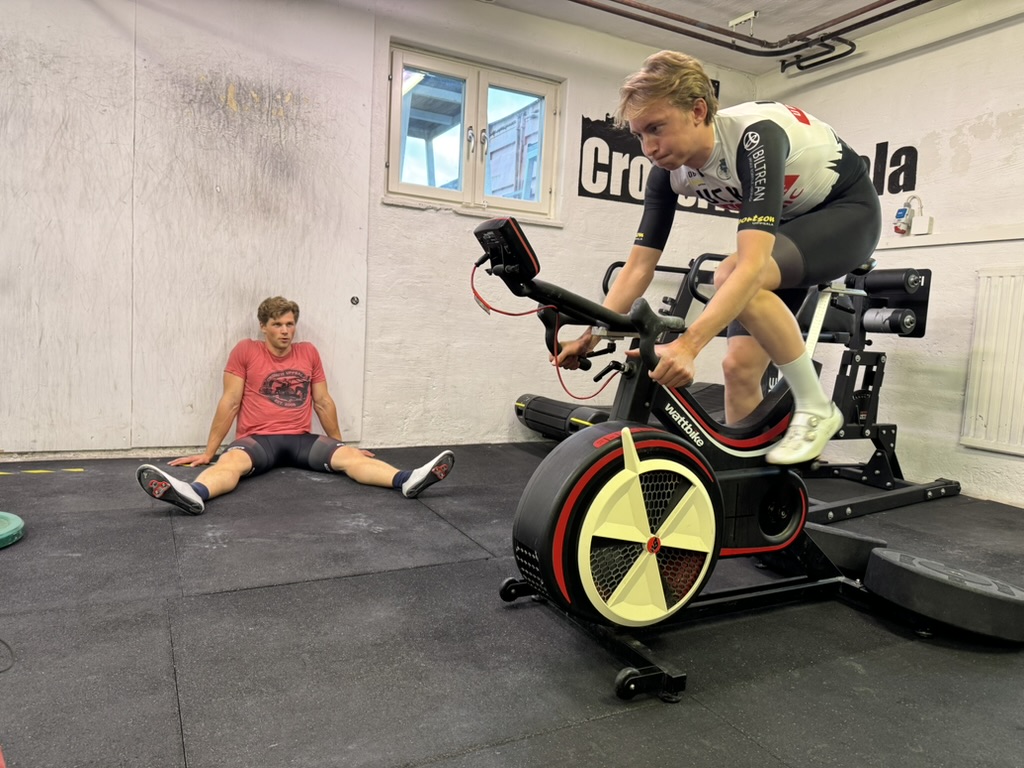
There is a simple mechanical rule we will follow during the cycling sessions: being able to drive force down into the pedals in a low aerodynamic position, keeping the body locked in a very low posture with bent arms, is difficult and getting good at it requires practice.
When you start from a standstill, air resistance is close to zero, and what holds you back is the inertia of the bike and rolling resistance. Here it is worth “sacrificing” aerodynamics, standing upright, and bracing against the handlebars to get maximal mechanical leverage and force down into the pedals. As soon as the bike is rolling at high speed, the relationship is reversed, and instead the air in front of you has become a solid wall.
Three quick arguments for why aero wins at speed:
Air resistance increases with the square of speed: if you double your speed, air resistance quadruples. This means that at the speeds we are aiming for (>50–60 km/h), more than 90 percent of our total energy is spent simply moving air out of the way.
The power requirement increases with the cube of speed: increasing speed in an upright position requires an almost exponential increase in watts. It is much easier for the body to reduce frontal area than to try to produce another 300 watts with the head held high.
Posture protects power: if you lose your tight aero position with your head and shoulders because you get tired, you become so wide that the drag slows you down more than any extra watts you might manage to produce.
We do not compromise our position in order to try to squeeze out more power.
Cycling Session 1 — Force and Start
This session focuses mainly on the standing start, force development from zero, and roll-up work, the part of the sprint where more force is often more, and where quality must be maximal. “More force” usually means “more speed” as long as technique holds together.
- 4–6 × standing start 6–8 s in a heavy gear. Rest: 4–6 minutes.
- 2–3 × flying 8–10 s from a rolling entry. Rest: about 5 minutes.
- 1–2 × 100–150 m roll-up reps, riding in toward an imagined start line with full acceleration. Rest: 5 minutes.
- 1–2 × 10–15 s at roughly 500 m pace and gearing. Rest: about 5 minutes.
Stop immediately if acceleration mechanics deteriorate or power clearly drops, because we want to train high quality (not “survive” our way through reps).
Cycling Session 2 — Top Speed and Cadence
This session trains terminal speed, optimal cadence, and coordination at high pedalling frequency, which is central in the flying 200 m, where the effort is short and mostly neuromuscular. Here you want to find the cadence and gear choice that lets you deliver top speed for a short time without technique falling apart, because fundamentally this is about force–cadence and the neuromuscular system rather than endurance.
- 4–6 × flying 8–10 s.
Choose gearing so that cadence at top speed lands in your planned range, and stop the set if cadence, posture, or the line you are holding deteriorates. The session is only meaningful when you are close to your best possible execution.
Cycling Session 3 — Force–Velocity Bridge and 500 m Rhythm
This session is a bridge between force-dominant acceleration and later sustained rhythm, and it is often where you start to get the first “500 m feel” without every attempt needing to become a complete slaughter session. Because the 500 m requires high power for 35–45 seconds, we want to gradually connect start skills to a more sustainable output without mechanics collapsing when fatigue begins to arrive.
- 3–4 × seated low-cadence start from a slow roll in a heavy gear, accelerating powerfully for 6–8 s with focus on force per pedal stroke rather than pedaling frequency. Rest: 4–5 minutes.
- 2–3 × 20–25 s at 500 m rhythm, rolling entry. Rest: 8–10 minutes.
Stop if force per pedal stroke collapses or if cadence runs away uncontrollably too early, because we want the reps to hit the right level of coordination rather than become a technically broken compromise.
Cycling Session 4 — Special Endurance 500 m
This session is special endurance in the 500 m window: the ability to maintain force when fatigue drives quality down in an almost entirely glycolytic anaerobic effort. Because the 500 m, and also the 1000 m, require us to maintain near-maximal force for 30–75 seconds, the ability to handle fatigue-related force loss becomes decisive.
The activation is done to “wake up” the nervous system and force–cadence before the main work:
- 1 × standing start 6–8 s. Rest: 5 minutes.
- 1 × flying 200 m. Rest: 5 minutes.
Main set, progression across loops proceeds as follows, and you choose the level that lets you maintain mechanics:
- First loop: 3 × 30 s, rest 8 minutes.
- Second loop: 4 × 35 s, rest 6 minutes.
- Third loop: extend the efforts further or reduce the rest.
Aim for even cadence through the efforts and accept a slight drop in speed toward the end, because fatigue affects the force–velocity relationship and it is expected that quality will drift; try to reduce or prevent this by actively focusing on pacing and technique. Choose gearing so that you start close to your planned cadence/speed and stop the repetition if cadence or posture collapses.
Cycling Session 5 — Special Endurance 1000 m
This session builds 1000 m rhythm and force retention over 60–75 seconds, where there is a significant aerobic contribution, roughly 30–40%, but where you are still fundamentally a sprinter who now needs to hold mechanics together under very high intensity. Here, pacing stops being philosophy and becomes technique: if you empty yourself too early, you pay dearly at the end when acidosis rises and cadence drops.
The activation is done to “wake up” the nervous system and force–cadence before the main work:
- 1 × standing start 6–8 s. Rest: 5 minutes.
- 1 × flying 200 m. Rest: 5 minutes.
The main set develops across loops of the session so that you can gradually hold high output longer (or at least for a long time) without quality falling apart:
- First loop: 2 × 50 s, rest 12 minutes.
- Second loop: 3 × 60 s, rest 10 minutes; or 2 × 70–75 s, rest 12 minutes. If the third repetition is clearly worse, stop at two.
- Third loop: extend the efforts further or reduce the rest.
For pacing, cadence, and individual gear adjustment, we want cadence never to rise more than 10 rpm above your optimal cadence. Take a quick look halfway through, around 45–50 seconds if you can, to confirm that cadence is now moving down toward roughly 10 rpm below optimal cadence, which is reasonable when fatigue begins to affect the force–velocity relationship. Stop immediately if posture on the bike cannot be maintained, or if cadence drops more than the planned drop, because the repetition has now left its target zone and risks becoming pure survival training, with poorer transfer and a negative effect on recovery.
Cycling Session 6 — Race Modeling and Testing
This session is both training simulation and measurement, and the idea is that you get race-specific efforts while also being able to track a trend over months. Structure A is used during the first two loops of this session and trains the ability to divide a race wisely, while structure B in the third loop is a “real” test that makes it easier to see where capacity is heading.
Structure A — broken race:
- 1 × standing start 6–8 s; rest 5 min.
- 1 × flying 200 m; rest 5 min.
- 2 × (250 m effort + 5 min rest + 250 m effort); rest 10 min between sets.
- Optional: 1 × full 500 m at the end, if you still have energy left.
Structure B — full test:
- 1 × flying 200 m; rest 10 min.
- 1 × 500 m TT or 1000 m TT, alternated loop by loop so that each event is tested roughly every sixth week.
Check that cadence at top speed in the flying 200 m attempt lands in your planned range, and if cadence is clearly too low or too high compared with what you expected, adjust gearing for your longer test as well; otherwise, you risk “testing gear choice” rather than capacity.
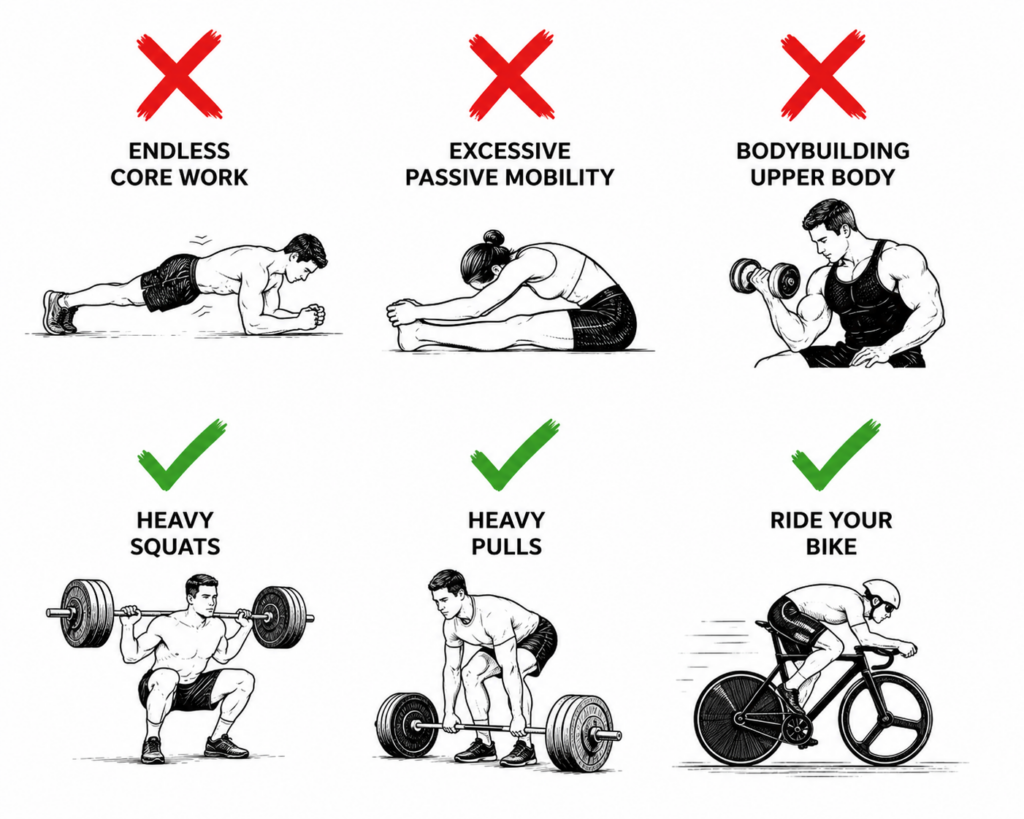
Before we get into how you generally adjust and fine-tune the dosing in this program, I want to briefly mention three things cyclists often overdo when building their training programs: low-back management, excessive mobility work, and unspecific or unneccesary upper-body strength training.
We Do Not Treat the Core as If It Were Made of Porcelain
It is well known that low back pain (LBP) is the most common overuse injury among cyclists. In large cross-sectional studies, around 55–58% of all cyclists report having had back problems during the past year (Streisfeld et al. 2017). This is primarily a problem for endurance cyclists, not a sprinter problem. The reason recreational and endurance cyclists suffer from this to a much greater extent is that they spend dozens of hours per week statically hanging over the handlebars, often with fatigued trunk musculature and without any real maximal strength. As a sprinter, you are more protected by exactly what you already do: you spend minimal time in the saddle, and the intensity of your starts and heavy lifts builds a trunk stiffness that road cyclists can only dream of (but perhaps should acquire).
If a sprinter gets back pain, it is almost always because of one thing: too much and too hard. When volume gets too high, neural fatigue accumulates and the timing of your bracing pattern starts to fail. When that happens, the classic reflex is to add traditional core-endurance training (planks, crunches, and “core sessions”). We do not do that.
It fatigues an already worn-down system and makes things worse. Exhausting the abdominal and back muscles with isolated fatigue training only makes them perform worse when you need to stabilize a heavy lift or a standing start. We build core strength through heavy squats, deadlifts, and cleans.
The solution when the back (or anything else) starts complaining is simple but mentally difficult for an ambitious athlete: keep the intensity but cut the volume drastically.
We Do Not Chase Passive Mobility
When the back or hamstrings feel tight, the next trap is to start stretching intensely, or to start doing yoga. It can look impressive when highly flexible yoga practitioners fold themselves in half, but for a sprinter that type of mobility is directly counterproductive.
Stretching has a place, but then it must be kept extremely individual and directed toward functional mobility under tension (not passive extreme range of motion).
Classic passive stretching and posture-focused yoga can temporarily reduce some of the back’s most important functions, and at high volume over a long period may also negatively affect the elastic system in three ways:
- Through reduced stretch-shortening cycle efficiency (SSC): sprint performance is connected to musculo-articular stiffness. Longer passive stretching reduces the system’s ability to store and reuse elastic energy, which acutely lowers explosiveness for 5–60 minutes afterward (Behm & Chaouachi 2011).
- Through reduced muscle tone and force development: prolonged passive end-range positions reduce neuromuscular force output (RFD) for up to an hour afterward, by 4–8% in meta-analyses of more than 60 seconds of static stretching (Simic et al. 2013; Behm & Chaouachi 2011).
- Through potential ligament creep: the deep structures of the back need to be tight to transfer forces according to McGill’s “stiff link” principle. Very aggressive mobility training over a long period may eventually affect passive structures (McGill 2010).
You want a stiff, springy, high-performing system (with mobility, but under tension).
You Are Already Training the Upper Body
EMG data show that muscles such as the latissimus dorsi, biceps, and deep back muscles are activated strongly when you push more than 500 watts on the bike (Turpin 2016). At a maximal sprint of 1500 watts and above, no direct EMG studies have been done, but it is mechanically reasonable that the demands increase further in roughly proportional relation to power output. Force transfer between handlebar and pedal is linearly linked to the net force in the pedal stroke, which means that the upper-body load in an all-out sprint in many ways resembles the load from strength exercises in the gym, especially for the lats, the deep back musculature (erector spinae), and the arms (biceps).
What makes this load especially effective is that the upper body is trained through several drastically different muscle lengths and positions: both in the standing position during acceleration, where you pull with almost straight arms and the upper-arm and back musculature is forced to work isometrically in a long, stretched position to lock the connection between handlebar and pedal, and in the seated position at top speed. There, force transfer is instead routed through deeply bent arms, so the biceps also must work under very high mechanical tension in a strongly shortened position.
Together with the gym work, our program therefore already covers almost everything:
- The entire posterior chain: spinal erectors, glutes, and upper back through deadlifts and cleans.
- Quadriceps and abdominal stability through squats.
- Grip strength and forearms through heavy barbell lifts.
The only genuinely physiological gap the program leaves is for the rear shoulder (posterior deltoid) external rotation at the shoulder joint, and stability around the shoulder blades. These are muscle groups that tend to weaken and become stretched out by cycling’s forward-leaning, rounded position. Adding a few exercises to strengthen these muscles and joints may not directly increase performance on the bike, but it does support neck and shoulder health, which is required to keep performing over time.
If you want to add upper-body training, keep it minimal and place it absolutely last in the gym sessions (or on a separate in-between day).
Three simple pulling movements totalling 5–10 sets per week are enough to close the gap in your general strength profile:
- Chin-ups or pull-ups (2–3 sets): lats, posterior deltoids, and elbow flexors. The free-hanging start position also provides a much-needed decompression of the neck and thoracic spine after track sessions. The most important movement if you only choose one.
- Seated rows or face pulls, plus seated presses with a barbell or dumbbells through a full range of motion (1–2 sets): posterior shoulder musculature and rotator cuff. A direct countermeasure against a rounded back and internally rotated shoulders.
- Deep dips (optional, 2 sets): balances the pulling movements. Dips are preferred over bench press because the deep extension in the bottom position places high (and necessary) demands on shoulder mobility, exactly the mobility that stiffens from hours in the cycling position and in front of the computer at work.
You do not need more than that. Building more volume than these only costs valuable recovery time that your legs and nervous system need for power in the saddle.
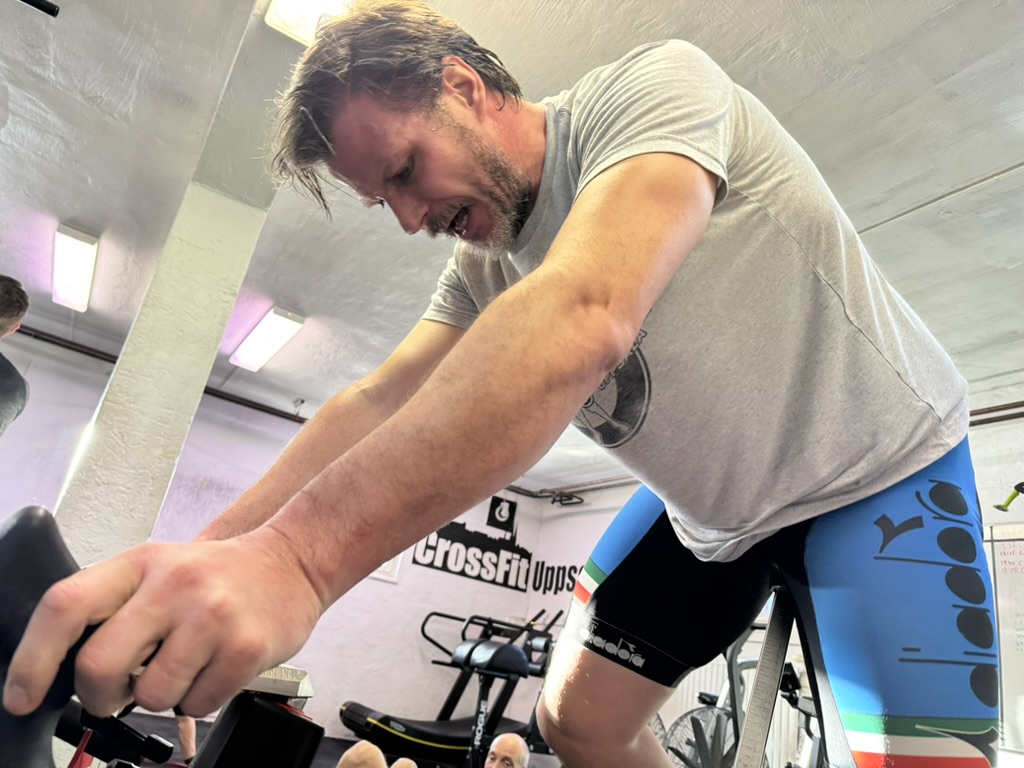
The program is a starting point, not a contract, and we should see it as a structure that helps us do the right things often enough for them to have time to take effect. At the same time, it is important to remember what actually makes us faster in this setup: building the engine (morphology and maximal force) and then expressing it on the bike under specific coordination and fatigue demands.
There will be (much) more on this in part 3, but to give some simple concrete triggers to help to adjust the program without starting to guess blindly.
- If a week falls apart because of work, illness, or life in general: reset to week 1 in the next loop.
- Race week: reduce to one cycling session (race modelling or activation only), no endurance training (one gym session, gym session 2 only, no heavy volume) and treat the race as cycling session 6.
- If CMJ height at the start of gym session 2 is clearly lower than normal: reduce the volume of the session or move it.
- If a repetition in a cycling session is clearly worse than the previous one: stop there. Do not build on broken quality.
- If aerobic filler increases fatigue without adding anything: stop doing it.
When you adjust, make one adjustment at a time so you can see what actually had an effect, and let quality in the main components be your compass. The most common reflex when fatigue accumulates or when quality in the main components suffers is to add more, but it should usually be to remove something (especially the optional components).
Finally: the test days and single performances do not tell the ultimate truth; they provide a trend over weeks and months, which is the time horizon required to build a real muscular foundation and tendon stiffness. A bad performance day almost always means that the day was bad, and much less often that you or the program is wrong.
SUPPLEMENTARY (FROM PART 1) REFERENCE LIST
- Behm DG, Chaouachi A (2011) A review of the acute effects of static and dynamic stretching on performance. European Journal of Applied Physiology 111:2633–2651. https://doi.org/10.1007/s00421-011-1879-2
- Bertuzzi R, Silva-Cavalcante M, Couto P, Azevedo R, Coelho DB, Zagatto A, Lima-Silva A, Millet G (2020) Prior upper body exercise impairs 4-km cycling time-trial performance without altering neuromuscular function. Research Quarterly for Exercise and Sport 91:613–622. https://doi.org/10.1080/02701367.2019.1708844
- Costes A, Turpin NA, Villeger D, Moretto P, Watier B (2016) Influence of position and power output on upper limb kinetics in cycling. Journal of Applied Biomechanics 32:140–149. https://doi.org/10.1123/jab.2014-0295
- Simic L, Sarabon N, Markovic G (2013) Does pre-exercise static stretching inhibit maximal muscular performance? A meta-analytical review. Scandinavian Journal of Medicine & Science in Sports 23:131–148. https://doi.org/10.1111/j.1600-0838.2012.01444.x
- Streisfeld GM, Bartoszek C, Creran E, Inge B, McShane MD, Johnston T (2017) Relationship between body positioning, muscle activity, and spinal kinematics in cyclists with and without low back pain: a systematic review. Sports Health 9:75–79. https://doi.org/10.1177/1941738116676260
- Turpin NA, Costes A, Moretto P, Watier B (2016) Upper limb and trunk muscle activity patterns during seated and standing cycling. Journal of Sports Sciences 35:1927–1937. https://doi.org/10.1080/02640414.2016.1179777