Re-presentation and coachning judgement
Six years ago, I watched an animated film on MUBI based on an essay by Steven Gerrard. I read the original article afterwards, and for reasons I still cannot quite explain, it has stayed in the back of my head ever since.
I am a coach and educator, not an philosopher. I am interested in philosophy, but care about it only when it sheds light on practical decisions on the gym floor. This is my attempt to find out why Gerrard’s arguments resonated so strongly with me.
For Gerrard’s essay, “Wittgenstein Plays Chess with Duchamp or How Not to Do Philosophy: Wittgenstein on Mistakes of Surface and Depth” (phew!) is certainly not a coaching paper and cannot be read as a theory of training. On top of that, it is a rather peculiar essay. A philosophical reading of the philosopher Wittgenstein staged through the artist (and chess master!) Marcel Duchamp’s chess analysis and one of his artworks, with one of the artist Max Ernst artworks as a counterpoint.
The article contrasts two ways of making the familiar strange. Duchamp changes an ordinary object’s location and status, making its relations newly visible; Ernst’s The Hat Makes the Man invites a reading in which an unfamiliar surface points to an underlying, hidden structure. Gerrard associates Duchamp with Wittgenstein’s attention to what is before us. Not as a denial of depth, but as a way of acquiring depth through clear and comprehensive description.
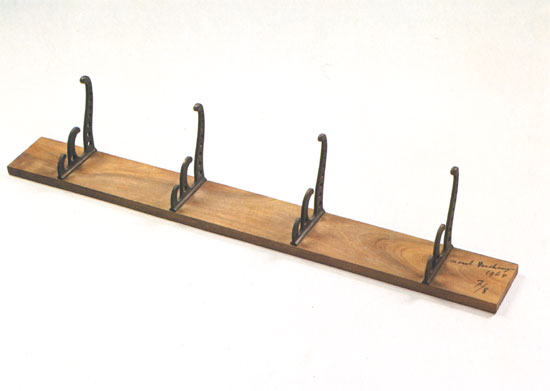
Marcel Duchamp’s Trébuchet.
Duchamp’s Trébuchet began as an ordinary, store-bought coat-and-hat rack, but Duchamp placed it on the floor of his studio.
Its visual economy matters: the object remains recognizably domestic and functional, yet its new position turns it into something one can trip over.
Gerrard follows the multiplying relations opened by that simple displacement (coat rack, medieval war machine, bird trap, measuring scale, stumbling), and the chess term trébuchet, in which the player obliged to move loses.
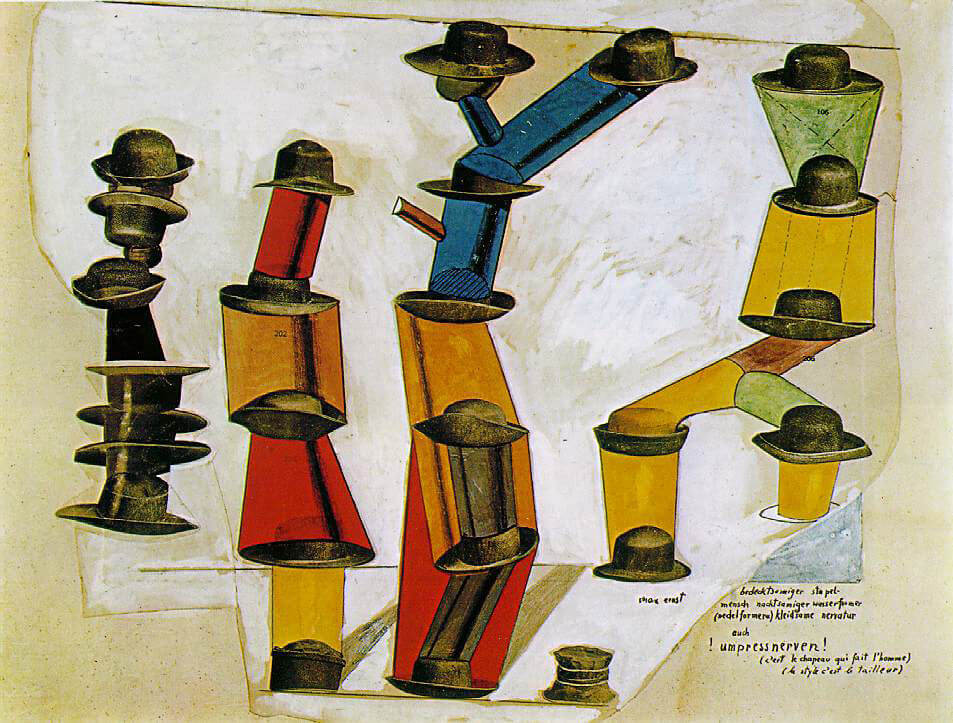
Max Ernst’s The Hat Makes the Man
Ernst’s The Hat Makes the Man aligns more closely with conventional visual art: a mixed-media collage of an anthropomorphic, hat-like form overlaid with strange, partly fabricated Germanic terms.
Gerrard reads its imagery and language as pressing the viewer toward hidden meanings, such as nerves, skeleton, covered seeds, and an apparently concealed interior. The work therefore makes the familiar figure of a man in a hat strange by suggesting that one must look beneath its surface.
So certainly, no theory of training, but I want to borrow that contrast as a mental lens for coaching judgment.
Duchamp takes an ordinary coat rack and changes its location and status: the familiar object becomes strange without acquiring an invented hidden interior. Ernst’s artwork, by contrast, makes the familiar strange through alien language and hints of an underlying skeletal or nervous structure. Gerrard uses them as examples for two ways of changing how one sees: a “surface” route allied to Wittgenstein’s attention to what is already before us, and a “depth” route that seeks what lies beneath it.
For coaching, the value of this contrast is practical (sports is a practical matter. It is not about words, but rather about actions). A coach must always act before having complete information.
Instead of searching for some hidden trait to explain an athlete, the relevant question is: “What slight shift in the environment will reveal the best path forward?”. This fits a very well into a constraints-led framework, where the coach manipulates training conditions so that both coach and athlete dynamically adapt.
A Duchampian coaching move does not make the session mysterious. It re-presents a familiar action in a different relation, so that an unnoticed feature of the action becomes visible.
Suppose an athlete competing together with a team moves efficiently when doing wall-balls alone but becomes hurried and inaccurate when synchronized with their partner. Preserve the load and target, compare a fixed shared tempo with athlete-negotiated tempo. The relevant issue may be timing information and mutual adjustment, not a generic loss of fitness. The coach has reorganized the visible situation so that the relation between social pressure, initial setup and outcome can be seen in a new light.
The important point is restraint. One changed condition is not meant to prove that the condition is the cause; but only makes a new distinction available. If the first rep changes only after the hard row, the next “question” can become more precise. If it does not, the coach can stop blaming the entry fatigue and reorganize another part of the episode. The test serves decision-making by ruling in or out a useful next action, not by supplying a universal diagnosis.

In this discussion what might call “the Ernstian error” describes a common coaching error: taking a relatively ordinary, describable episode and making it less intelligible by burying it beneath an alluring hidden explanation.
Gerrard’s (Wittgensteinian) warning is directed at the urge to posit something extra behind ordinary activity when description has not yet been exhausted. He argues that the temptation is to infer a hidden mechanism and then allow that inferred mechanism to become the criterion and guarantee of the activity.
In coaching, obscuring often takes familiar forms:
- The trait label. “He is not mentally tough,” “she has no engine,” or “he has poor body awareness” replaces an episode that could simply have been better described: the athlete changes pace after a particular transition, avoids a particular initiation, or loses a particular position at a known rep range.
- The hidden-mechanism leap. A single breakdown under pressure becomes “central fatigue,” “nervous-system inhibition,” “lack of sufficient strength,” or some hormonal story without the contrasts that make those explanations more plausible than alternatives.
- The complexity ritual. A coach adds load, fatigue, novelty, competition, and multiple skill changes at once, then reads the result as evidence of transfer. Obviously, many new things will happen when we change the task in so many ways, but they are likely not information about the original struggle, as the athlete is now just trying to survive an uninterpretable new task.
- The familiar-test illusion. A programme trains a benchmark’s order, density, equipment, and pacing rule, then treats an improved benchmark as proof of a general capacity.
- The measurement trap. Difficult tests that produce large score sheets but does not change the following week’s choice. It gives the appearance of control while adding little information. You have an FTP of 296 W, or a VO2Max of 58 L/min? what, exactly, are you going to do with that data?
This is not to say that because coaches should never theorize, but warnings to do so before the case has been organized well enough to deserve it.
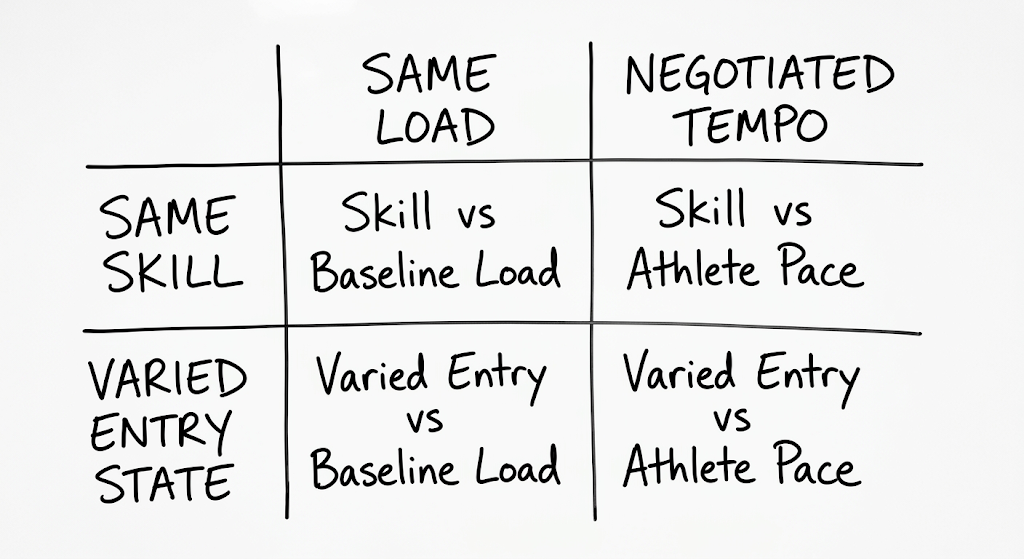
What Wittgenstein might add to coaching judgement is
-
Seeing connections rather than accumulating explanations.
Wittgenstein’s way of presentation is a useful model for a coaching record. It may consist of a comparative framing: same skill / different entry state; same entry state / different load; same load / athlete-selected versus prescribed pace. This does not add but arranges existing facts so that relevant contrast can be seen.For example, a runner’s “late-race collapse” can be reorganized into: pace through the first 10 minutes, pace after a surge, breathing pattern, terrain, fueling, choice of response, and the first point at which the athlete stops following the intended plan.
The next action may be a short surge-and-settle interval, a pacing choice with no live display, or a change of fueling. It is not automatically “more threshold work.”
-
Intermediate cases are more useful than binary labels. Wittgenstein’s emphasis on intermediate cases counters coaching binaries such as “has the skill / does not have the skill,” “fit / unfit,” or “confident / not confident.” A capability may be available fresh, after a short delay, with a fixed pace, after one transition, but not after a different transition. Those are not irritating exceptions to a clean diagnosis; they are the shape of the performance problem.
-
Rules does not eliminate judgement
Obviously, we need rules, delimitations for clarity and stability. But a program, an “EMOM prescription”, a heart-rate zone, or a scaling rule cannot mechanically determine the right next action. They are part of a practice in which the athlete, task, and context matter.This does not license improvisation without discipline. It asks the coach to make their rule use visible: What situation does this choice in our training fit? What would count as a reason not to apply it today? What observation would make a different choice more appropriate?
-
The coach is also part of the situation.
We are all guilty of path dependence, the tendency to just do the same things repeatedly without really think about its benefits here and now. Every coach has favourite explanations, preferred training modalities, some parts of the plan already written. The issue is not private bias, but whether the coach can create a test that might genuinely open up for other interpretations as well.A better question after a disappointing performance is therefore not only “What did the athlete fail to do?” but also “What did my programme make easy to see, and what did it hide?” That question turns reflection into a design responsibility.
A good coach might work well with many possible athletes, but it takes a master coach to work well with exactly the one in front of him.
-
Aspect-seeing might change the the coaches question.
Wittgenstein’s duck–rabbit discussions and Gerrard’s account of changed perspective suggest a disciplined question: Why am I seeing this as this?A missed clean may appear as weak legs, a rushed transition, a failed pacing decision, a grip-management problem, or an attempt to cycle when singles are the appropriate solution. These are not merely competing verbal interpretations. Each one implies a different training task and a different observation rule.
In that sense, good coaching judgment resembles the chess player who does not rush to take the obvious pawn: the relevant information is already on the board, but a change in attention is required to recognize it.
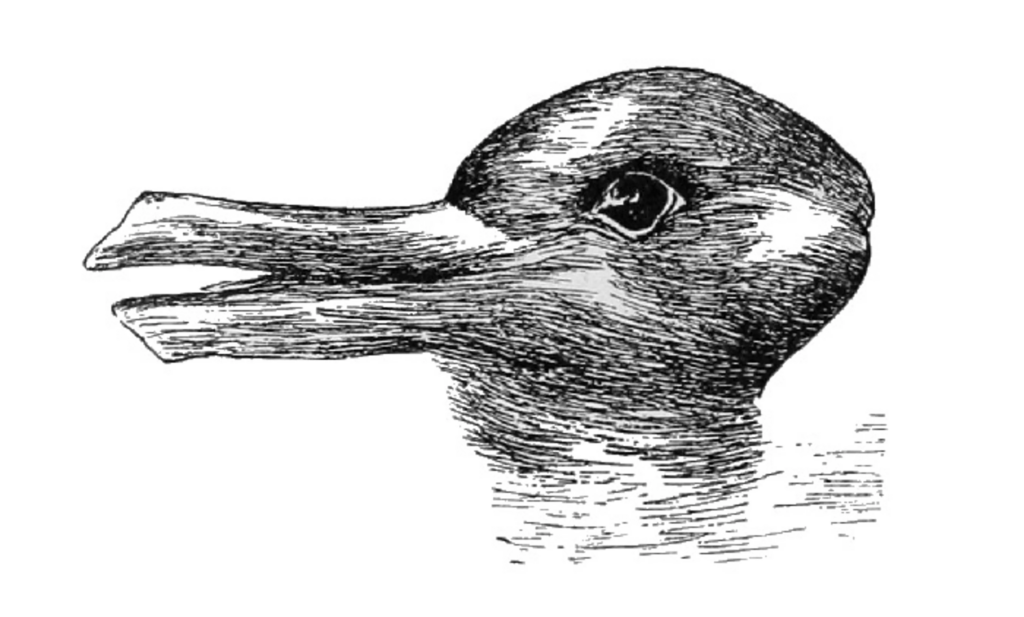
The duck-rabbit is a famous ambiguous image used in Wittgenstein’s philosophical work Philosophical Investigations to illustrate aspect perception
The better practice is not constant novelty, but it is also not mystery. It has four marks:
- It begins with an episode, not an athlete type. “After the third hard transition, he delays the first muscle-up attempt” is actionable. “He lacks strength” is not.
- It preserves a meaningful action while changing one condition. This creates a contrast, not a random challenge.
- It observes process as well as score. What we look for might be first-rep setup, time to initiate, break selection, or changes in form (not only completion time).
- It lets the result revise the coach. If the expected pattern does not appear, the presumed explanation loses authority.
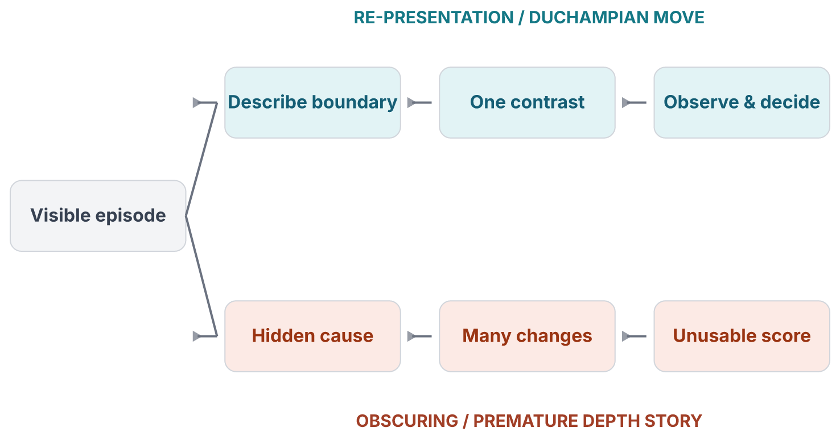
Re-presentation rearranges a visible episode to create an informative contrast, while obscuring moves prematurely from a visible event to a hidden explanation.
Concrete example: barbell cycling after a machine transition.
An athlete cycles five moderate power cleans cleanly when fresh. In a competition-style piece, after a hard 15-calorie row, she arrives at the bar quickly, takes two unplanned breaths, rushes the first pull, and catches the first two repetitions forward. She can then complete deliberate singles at the same load.
The obscuring response is to decide that she “lacks engine”, “loses motor control under fatigue”, “is too weak”, or needs harder mixed workouts. The re-presentation response is to keep the barbell task and load constant, compare an easy-row entry with the standardized hard-row entry, and observe first-rep set-up, time to initiation, catch position, and chosen break pattern.
If the disruption appears only after the hard entry, the next task can develop retrieval and transition strategy under that specific disturbance; if it appears in both conditions, the coach should would be wise to reorganize a different part of the episode (rather than deepen the first explanation.
The practical discipline is simple (though not easy): describe the episode, arrange a small contrast, watch what changes, and allow that result to alter the next decision.
So, while that article is certainly not a coaching paper, and neither art nor the philosopher Wittgenstein have have much to do with training theory, they can offer a way to resist a detremental coaching temptation: mistaking the familiar for understanding and mistaking an impressive explanation for seeing clearly.
READ MORE
- Wittgenstein Plays Chess with Duchamp or How Not to Do Philosophy: Wittgenstein on Mistakes of Surface and Depth. https://www.toutfait.com/wittgenstein-plays-chess-with-duchamp-or-how-not-to-do-philosophywittgenstein-on-mistakes-of-surface-and-depth/
- Orth D, Kamp J van der, Button C (2018) Learning to be adaptive as a distributed process across the coach–athlete system: situating the coach in the constraints-led approach. Physical Education and Sport Pedagogy. https://doi.org/10.1080/17408989.2018.1557132
- Pinder R, Davids K, Renshaw I, Araújo D (2011) Representative learning design and functionality of research and practice in sport. Journal of Sport & Exercise Psychology (JSEP). https://doi.org/10.1123/JSEP.33.1.146
- Kiely J (2011) Periodization, planning and prediction: A new perspective? https://www.researchgate.net/publication/264544386_Periodization_Planning_Prediction_And_why_the_future_ain't_what_it_used_to_be
- McCosker C, Renshaw I, Russell S, et al (2019) The role of elite coaches’ expertise in identifying key constraints on long jump performance: how practice task designs can enhance athlete self-regulation in competition. Qualitative Research in Sport, Exercise and Health. https://doi.org/10.1080/2159676x.2019.1687582
- Czyż SH, Wójcik AM, Solarská P (2024) The effect of contextual interference on transfer in motor learning - a systematic review and meta-analysis. Frontiers in Psychology. https://doi.org/10.3389/fpsyg.2024.1377122
- Czyż SH, Wójcik AM, Solarská P, Kiper P (2024) High contextual interference improves retention in motor learning: systematic review and meta-analysis. Scientific Reports. https://doi.org/10.1038/s41598-024-65753-3
- Till K, Muir B, Abraham A, et al (2019) A Framework for Decision-Making Within Strength and Conditioning Coaching. Strength and conditioning journal. https://doi.org/10.1519/SSC.0000000000000408